
Explore Articles Filed Under: Books and Art

There is a Greek word, hamartia, which is usually translated as tragic flaw, although it connotes more a cognitive than a moral failing — the lack of an important insight, a misperception, a blindness, a failure to perceive ethical and spiritual consequences. The idea of hamartia is often ironic; the very strength that makes the protagonist a hero is what brings about disaster.
I just thought I would pass along links to two recent articles people may have missed but are worth looking at. The current issue of Scientific American has an excellent summary of recent work on the mechanisms of hallucinogens, which, using animal models, appears to locate their site of action in pyramidal neurons in layer V of the somatosensory cortex.
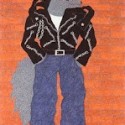
Coyote the trickster — generous and greedy, crafty and impulsive, clever and reckless — is not dead yet. Coyote is the great cosmic creator and the clumsy destroyer — as literary critic Franchot Ballinger puts it, “a force of multifarious creative energy.” Coyote is killed, chopped up, crushed, and destroyed, yet always comes back to life, sometimes wiser and sometimes not, just like the indigenous peoples of North America who created him.
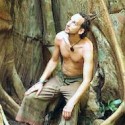
Daniel Mirante is a young — thirty years old, which is young to me — visionary artist, author, and researcher fascinated with deep ecology, shamanic traditions, ancient mythology, and the creative process. In 2000, he founded the well-known Lila website — the word lila means something like cosmic play in Sanskrit — as a creative collective and resource for people exploring what Delvin Solkinson of the Elfintome Arts Collective has called medicine culture — shamanic forms of creativity and healing, including plant-based entheogenic practices.
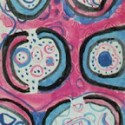
A number of artists have attempted to render the striking visual experiences that occur after ingesting ayahuasca or DMT. In the Upper Amazon, there are both indigenous artists, whose traditional work consists largely of abstract patterns, such as those found on the now well-known pottery, clothing, and other household goods of the Shipibo; and visionary artists, mostly mestizo, whose work is characterized by detailed representations of spirits, trees, animals, objects, and participants in ayahuasca healing ceremonies.

I have always been a big fan of Terry Riley. I still have my original 1964 vinyl pressing of his In C, which burst on the classical music scene like a revelation — minimalist, aleatoric, melodic, haunting. His musical trajectory has carried him beyond minimalism to a sometimes startling eclecticism, but all his music is shimmering, luminescent, and beautiful. My teacher don Roberto Acho spoke of the singing of the plants as being puro sonido, pure sound; Riley writes, in the same sense, pure music.

While visiting one of my favorite websites, Bioregional Animism, and its accompanying blog, I saw some striking sculpture by Martin Bridge, an artist and teacher who lives in western Massachusetts. His website shows the range of his work — sculpture, installations, drawings, paintings, theater design, book illustration. He is a mask maker and a drummer, one of the founders of the Ritual Arts Collective, and he is a second-generation art teacher, head of the Visual Art Department at Pioneer Valley Performing Arts Charter High School, where he teaches Visual Art and Theater Design and Production.
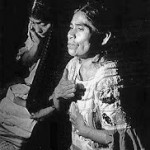
In 1955, banker R. Gordon Wasson, an amateur connoisseur of mushrooms, was introduced by the Mazatec shaman María Sabina to the ancient teonanácatl — the Psilocybe mushroom, called ‘nti-ši-tho in Mazatec, Little-One-Who-Springs-Forth. María Sabina called them her saint children. Wasson was deeply impressed by his mushroom experience. He speaks of ecstasy, the flight of the soul from the body, entering other planes of existence, floating into the Divine Presence, awe and reverence, gentleness and love, the presence of the ineffable, the presence of the Ultimate, extinction in the divine radiance. He writes that the mushroom freed his soul to soar with the speed of thought through time and space. The mushroom, he says, allowed him to know God.
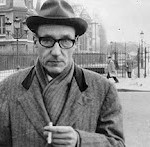
American novelist William S. Burroughs ended his first book, originally published as Junky under the pseudonym William Lee, with a brief meditation on yagé. “I read about a drug called yage, used by Indians in the headwaters of the Amazon,” he writes. “I decided to go down to Colombia and score for yage. . . . I am ready to move on south and look for the uncut kick that opens out instead of narrowing down like junk.” The last sentence in the book reads, “Yage may be the final fix.”

Just what we need. More bad press about psychotropic mushrooms. You see, not only do they make you trip out, so that you cannot defend yourself from slobbering, inbred, axe-wielding halfwits, but they also engender extreme rage and violence, communications with the dead, and awful visions of the future. At least that is the premise of the horror-slasher movie Shrooms.
Most Popular Articles

Explore by Topic
- Ayahuasca (91)
- Books and Art (68)
- Indigenous Culture (88)
- Jungle Survival (16)
- Legal Issues (10)
- Meditation (5)
- Plant Medicine (33)
- Research Studies (31)
- Sacred Plants (74)
- Shamanism (116)
- The Amazon (90)
- The Medicine Path (28)