
Explore Articles Filed Under: Indigenous Culture

Tiwanaku is an important Pre-Columbian archaeological site in western Bolivia. Tiwanaku is recognized by Andean scholars as one of the most important precursors to the Inca Empire, flourishing as the ritual and administrative capital of a major state power for approximately four hundred years between 700 and 1100 A.D. There has been good reason to believe that the inhabitants of Tiwanaku utilized an insufflated hallucinogen. They produced a variety of small carved objects that included puma and jaguar effigies, incense burners, and decorated wooden snuff tablets. Many mummies and skeletons from this culture were buried with such tablets and snuffing kits. One archaeologist reported recovering 614 snuffing kits from a single excavation.
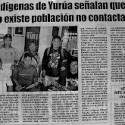
Andy Graham at HoboTraveler has pointed to an article in the Pucallpa newspaper Diario Ahora, dated June 5, 2008, with the headline Indígenas de Yurúa señalan que no existe población no contactada, Indigenous People of Yurúa Say There Are No Uncontacted Populations.
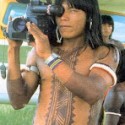
Indigenous people all over the world are already embedded in global modernity, whether anyone likes it or not. There is no turning back, no way to disengage from the modern world, nowhere for indigenous peoples to retreat. And I think it is fair to say that indigenous people are, generally, worse off in many ways since this change than they were before. Still, there are aspects of modernity — modern dentistry, for example — which could be of benefit to indigenous people if they had access to them.
There is an ambiguity inherent in shamanic practice, where the dangerous work of healing and sorcery intersect. Because shamans possess spirit darts, and with them the power to kill, the boundary between sorcerer and shaman is indistinct. Such shamanism, says social anthropologist Carlos Fausto, “thrives on ambivalence.” In the Upper Amazon, life and death are inextricably intertwined, and the cosmos is conceptualized in terms of predator-prey relationships.
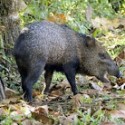
In the Amazon, plants and animals are ascribed the status of persons, who may differ corporeally from human persons but, like them, possess intentionality and agency. Indeed, other-than-human persons are believed to see themselves in human form, and thus to be self-aware of their own personhood. Among the Ashéninka, for example, a white-lipped peccary is held to perceive its own herd as a foraging human tribe, its wallow as a human village, and the wild root it eats as cultivated manioc.
Harry West is an anthropologist who currently teaches at the University of London. Back in 1994, he spent a year living with the inhabitants of the Mueda plateau in northern Mozambique, studying, among other things, their ideas about sorcery. One of the things he learned was that, when the villagers saw a lion, they often speculated that it might not be an ordinary lion, but might instead be a sorcerer who had turned into a lion, or a lion that had been created by a sorcerer, and was in either case intended to eat the flesh of the sorcerer’s enemies, either through a physical attack or by causing chronic sickness.
In the Upper Amazon, people believe that there are sorcerers, and that much of human suffering — sickness, death, misfortune, bad luck and trouble — is caused by sorcerers, either from the sorcerer’s own malevolence, or on behalf of an embittered and resentful client. There is little that the ordinary state apparatus can do about sorcery. Alejandro Tsakimp, a Shuar shaman, puts the thought this way: “They killed my father with witchcraft and not with a bullet…. With killings like this, through witchcraft, there aren’t any witnesses. I can talk about all this, I can go to lawyers, but nobody will believe me.”
Mestizo shamanism is found in an arc from southern Colombia and Ecuador to northern Bolivia, through the present-day Peruvian departamentos of Loreto and Ucayali, westward along the Río Marañon, and spilling over eastward into western Brazil. This distribution is the result of historical factors, one of which was the great Rubber Boom — a period of about thirty-five years, approximately from 1880 to 1914, which transformed Amazonian culture in ways both profound and irremediable.
On the planet Sarkovy, one of the many imagined by science fiction writer Jack Vance, the inhabitants, called Sarkoy, are experts in the art of killing by poison. An adept of this art is called a venefice, and it is believed that a Master Venefice can kill a victim merely by walking past him. The venefices of Sarkovy are amateurs compared to sorcerers in the Upper Amazon. Throughout the Upper Amazon, people believe that they can be made sick through ingestion of noxious substances prepared by their enemies and put surreptitiously in their food or drink — bat saliva or phlegm, the burnt bones of dead humans mixed with the entrails of water snakes, the blood of a black dog.

There has been a lot of press lately about the discovery of a previously uncontacted tribe along the Peru-Brazil border. There are pictures of a village from the air, with painted indigenes aiming their arrows at the airplane. Quaint, childlike Indians! There is a rush now to protect them, like an exotic threatened species, the way we protect the rainforest itself, for our future use.
Most Popular Articles

Explore by Topic
- Ayahuasca (91)
- Books and Art (68)
- Indigenous Culture (88)
- Jungle Survival (16)
- Legal Issues (10)
- Meditation (5)
- Plant Medicine (33)
- Research Studies (31)
- Sacred Plants (74)
- Shamanism (116)
- The Amazon (90)
- The Medicine Path (28)