
There are relatively few women shamans in the Amazon, and certainly few among the mestizos. On the other hand, my teacher doña María Tuesta said that she had encountered very little prejudice because she was an ayahuasquera. There were some shamans who have said that she should not be a healer, but — in her typical way — she said that those were all stupid people with no shamanic power anyway. Still, her vocation is rare. Rosa Giove, a Peruvian doctor at the Takiwasi Cenetr in Tarapoto, reports that, in twelve years of investigation, she has known only two women who heal with ayahuasca. One is an elderly Quechua-speaking woman from Lamas, who lives in isolation, feared in her village as a bruja, a sorceress; the other is well known in Iquitos, but with fewer patients than the male ayahuasqueros, despite the fact that their methods are similar.
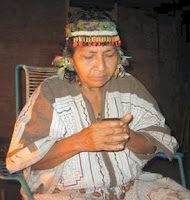 |
| Ayahuasquera doña Norma Aguila Panduro Navarro |
I know of just two female mestizo shamans — doña María, and doña Norma Aguila Panduro Navarro, who, until her recent death, performed healing ceremonies at Estrella Ayahuasca, her Centro de Investigaciones de la Ayahuasca y Otras Plantas Medicinales between Iquitos and Nauta.
There are some limitations on women both as shamans and as patients. Among most Amazonian groups, women do not drink ayahuasca at all, primarily because of fear of spontaneous abortion; the Shuar are unusual in that there is no difference in ayahuasca intake based on sex. Among the Shipibo, for example, the women are the sole possessors of the ayahuasca-inspired designs with which they decorate their pottery and clothing, yet the women themselves do not drink ayahuasca.
Doña María expresses these limitations based on concerns about menstruation. As we have discussed, ayahuasca and the other plant spirits are celosa, jealous, which means, among other things, that they do not like the smell of human sex, semen, or menstrual blood. For that reason, doña María told me, the plant spirits will not go near a woman who is menstruating.
Thus, a female curandera cannot work while menstruating; that restriction means that the most powerful ayahuasqueras will be post-menopausal. And a menstruating woman among the participants at a ceremony will disturb the shaman’s concentration and impair the visions of everyone present. Such a participant can drink ayahuasca, I was told, but she will not receive the full benefit of the drink. Soplando, blowing tobacco smoke, on the menstruating woman — all over her body, beginning from the crown of her head down to the soles of her feet — may mitigate but does not eliminate the problem.
A woman, too, doña María told me, should not drink ayahuasca while lactating, for reasons that she did not make clear — only that ayahuasca should not be in the breast milk. On the other hand, a woman can drink ayahuasca when she is pregnant, because the ayahuasca gets into the child and gives it fuerza, power. The same belief is found among the Shuar: some women express the belief that a child is born stronger if it receives the beneficial effects of ayahuasca while still in the womb.

- Previous Post: Shrooms
- Next Post: How Plant Spirits Appear
- More Articles Related to: Ayahuasca, Shamanism, The Amazon



Dear Steve,
Thank you for the article. As a woman, I would like to meet an ayahuasquera. I am half Ecuadorian half German currently studying homeopathy. My daydreams take me to the jungle. I speak Spanish and would like to go to the Amazon this year. Is Ayahuasquera doña María Tuesta Flores still alive? Can you help me find her?
Thank you!
I went to a ceremony held by an ayahuasquera in costa rica. I was menstruating and she gave me a protective necklace and red string around my ankle. My journey was soft, beauriful and gentle and I did not feel any jealousy from the spirits. Ayahuasca is my teacher and my sister, I do not believe she would shun me while I was bleeding but I do not have a lot of experience. That was just my second journey. There were only 3 of us, all women including the shaman.
Hi Andrea,
I’m half Ecuadorian too. My mother is from Ecuador and my dad is Scots-Irish. I really wanted to try Ayahuasca in Ecuador. I found Gaia Sagrada near Cuenca. That is where I am now. For the first time, I feel connected to my mothers ancestry.
I know your post was a long time ago, but if you are called, I would suggest you coming to Gaia Sagrada and working with the shamans here. There are three Ecuadorian female shamans and one male shaman who is from Mexico and married to an Ecuadorian shamana.
Good luck!
Kelly
Alas, doña María passed on just four years ago, in July 2006. She is now, I am sure, giving her healing baths to the children of the angels.
As usual, excellent writing that raises many interesting questions.
There are more ayahuasqueras, few with public recognition, at least one other who is dying:
http://vimeo.com/13167559
For so long, so very many contradictory tall tales have been told about women that women even begin to believe without question those tales themselves, even wise and powerful women. We are told we are only at our greatest potential when we can bear children … or conversely when we can’t. Or truly feminine when we are menstruating … or not. Or we are only powerful or wise or worthy or clean or beautiful or valuable under so many bizarre cultural circumstances. Are any of them real or true? Who knows, but these ideas about women and power often serve to subtly direct and limit what women believe they themselves can do, and it seems to me to be the case as well sometimes with ayahuasca.
Ayahuasca is certainly subject to cultural norms in which it is used, and I can’t help but wonder how much of the influence of South American machismo culture has influenced the understanding of the role women have to play as ayahuasqueras. One wonders if, as ayahuasca makes its way into the further reaches of the globe, if women will suddenly find their role more accepted, respected, and even needed. Perhaps more defined by women themselves. Or will we continue to believe that menstruation somehow makes us untouchable because it’s been said so many times, even by wise and wonderful women? I can’t speak for anyone but myself, but the teachers I have worked with have never placed this limitation on the women they work with, nor have women seemed to struggle with it.
In the North American native traditions I am familiar with, half seem to ostracize menstruating women. The other half seems to not worry about it at all. Some find a gentle way to squirm an excuse out, claiming that “A woman is in her own ceremony at her moon time so she can’t be part of ours.” There seems to be such disagreement all around about the appropriateness or inappropriateness of menstruating women. Because of the widespread disagreement, I suspect that the problem is not actually menstruation and how the spirits do or do not feel about it, but the fearsome hubbub that humans themselves make about it.
i for a long time felt that women were greatly shunned for their periods. i know feel very differently. i am an apprentice ayahuasquera. i have drank the medicine many times. i agree that the spirits do not like the smell of menstrual blood. i have sat in many ceremonies on the verge of bleeding, bleeding, and not bleeding. as well as with other sisters in the same way. sooner or learner u realize that the heaviness of the flow in your body is a very powerful process and that u would much rather be sitting on a heating pad at home in the comfort of your house. over the past four years i have witnessed so many women come to this conclusion. and that brings me to this. we have stepped out of our moon lodges to compete with men because we have had too. it doesn’t make it right it is what it is. but the moon lodge is a powerful place. it is a place that we can refind and use if we want power. it is not an easy place. the native americans used to initiate their young women into the lodge by having them sit in a pit with a deer skin over their heads for the first part of the rites. there was a mystery in that . it is lost now. but for the women who has the courage to go within and rediscover what it was. well the journey begins in the quite of the blood.
Hi Koa,
I’m wondering if you would elaborate on the effects of Aya when ‘on the verge of bleeding’. What can you say about your experience of journeying just before flow?
I trust that you have gained insight on this topic through your personal experiences. And there are others who have expressed safely journeying with Aya during their cycle.
I am soon to journey and expect that my cycle will begin one day after the last ceremony. Any information you can provide me with will be helpful. I am seeking to better understand this topic. Thank you.
The purpose of ceremony in native american cultures is to cleanse. When women are on their moon, they are cleansing naturally and so they don’t NEED ceremony… their presence in ceremony while on their moon is too powerful.
I have heard directly from shamans from the Kofan tradition in Equador that women sit all the time, pregnant or no. I have been in many Kofan ceremonies with children present, and nursing mothers (with their babes in ceremony). I know women who specifically chose to give the gift of the medicine to their unborn children.
When menstruating they wear a red belt with tobacco ties – not for their sake but because, as is believed by Northern Native Americans, that they are extremely powerful (magnetic) and can accidentally have a big effect on the energy of the ceremony.
Regarding pregnancy I was told specifically that it was ok from conception to 6 months and that the last three months neither the mother or father should partake. But I was recently in a ceremony (not with Kofan, but Northerners) with a woman who was 8 months pregnant – she had a light, beautiful experience and is now a proud parent of a healthy baby. Regarding breastfeeding, that as during pregnancy, it is beneficial medicine.
This is all first person experience.
Online I have read accounts of women taking ayahuasca during childbirth.
Regarding women as curanderas, it’s been my observation that many shamans work in with their partner. A couple, man and woman, working in concert as healers, is a beautiful thing to witness, creates very balanced energy and embodies the concept of the human family / tribe very beautifully.
Historically, ayahuasca has been used a lot for inter-tribal warfare (sorcery). Also, there is an aspect of facing death, of standing on the edge as it were, to being a medicine carrier. These are very masculine principles. David Deida, an author and teacher focusing on sexuality in spiritual context, posits that men (or masculine women) have a drive to face death (deep spirituality falls into this – ego death, etc) and points out that most traditions involving extreme spiritual practice are primarily groups of men (of course there are exceptions) monks, priests, etc. Women, shakti, are an expression of life itself, of abundance, the polarity to nothingness, everythingness and therefore full and content to just BE in life, celebrating it, living as an embodiment of it.
Some would say we’ve been in a thousands of years long season of patriarchy and are entering a matriarchy – so expect to see more and more women stepping into leadership roles. I guess time will tell :)
Personally, I do not think any details matter. If you can open your heart, get your head out of the way and listen to spirit, access your inner Self, the Creator, God (whatever framework you choose) – the answers are all there, all within. Regardless of your gender, do the work you are called to do.
I appreciate this discussion…I went to ceremony for the first time this past Friday and found this through researching if it could be why my period is now late (I don’t believe I’m pregnant but I suppose it could be possible). I’m very happy I came across this thread because I had been nervous going in as a nursing mom, there was another mom there which helped and this thread too is very comforting.
<3
Hi! I saw your comment, I guess it is over a year ago, but I was wondering if you did take Aya while breastfeeding? Did it have any effect on the baby? I am having doubts since I don´t have a way to pump my milk out and haven´t been able to find a lot of information about it. Thanks!
Thank you for this thread. I am about to do it for the first time this evening, and have been a little nervous, but this has put my mind at ease. I feel like the time and opportunity is right for me. I have just reached the end of my menstrual cycle, and wasn’t sure whether to go through with it so close, but I think I will now. I hope the spirits aren’t too jealous :)
During my third session with the plant medicine (first with my partner), I experienced a soft, beautiful journey through my wombspace and felt like I had immaculately conceived a child spirit with my partner. The next session, two nights later, the plants told me I was actually pregnant and was introducing me to spirit of my child and that I had to consciously make a decision in that moment to either purge and remove the child from my body or endure the full experience. It was quite the journey as I had experienced the healing benefits through purging all previous times. This night was a full moon and usually I receive my moon cycle on the full moon… next morning I took a pregnancy test and was indeed well into my first month of pregnancy… so blessed for my little aya sprout. We are naming her Ayah Jade and expecting her in September 2014 <3
Hi did you drink ayahuasca again during your pregnancy
How sick can you be to use drugs while you’re pregnant?
Este es un mensaje para Marytierra, ya axisti a bastantes ceremonias en las que habia madres lactantes con sus hijos, sobre todo en brasil en la comunidad del santo daime es muy comun ver embarazadas y niños. Incluso una de ellas con las que coincidi varias veces estaba embarazada de 8 meses y dando el pecho a su otro hijo de 11 meses. Por norma general los niños se quedaban dormidos despues de mamar, pero hubo una vez que el niño estaba claramente en proceso tambien y tenia la vista perdida y le costaba mantener el equilibrio (los niños de 7 meses ya se sientan y el no era capaz en ese momento). Y era curioso porque cuando lo tenia cogido su madre no paraba de moverse y agitar las piernas pero si lo cogiamos alguna otra persona se relajaba… esta claro que en su proceso estaba sanando alguna relacion con su madre, quizas hasta de una vida pasada. Lo mas impactante es que por mucho que todo esto ocurriera, el niño no lloro ni una vez en las 8 horas del trabajo, por lo que estoy segura que la madre ayahuasca lo eataba cuidando bien. Tambien vi a niños menores tomando y todos son pura luz el que mas un bebe que empezo a tomar del pecho de su madre y su primera vez ingerida fue un trozo de sandia mojad en un vaso con ayahuasca disuelta en agua. En tema embarazo he visto de todo, pero un amigo que se dedica a analizar substancias psicoactivas en un laboratorio en barcelona, me dijo que no era recomendado los tres primeros meses de gestacion por la formacion del bebe ni en el ultimo por poder provocar un parto prematuro debido al pulso acelerado y a la agitacion abdominal.
Independientemente de todo lo que puedas leer, no hay nada como sentirte a ti misma y actuar en consecuencia. Eso si, si decides axistir a la ceremonia con tu bebe es muy recomendable que te lleves a alguien de apoyo para que te ayude en el caso de que el no se duerma. En algun momento te vendran bien unas manos amigas que le cojan y asi tu poder hacer bien tu trabajo y centrarte en tu proceso.
Un abrazo a todos
Good day. May I ask why ceremoni during bread feeding is not recommended?
Looking forward!
Well, I guess that should be present tense given the timing of my reply hehe! ;)
So glad to see this thread. I’ve been blessed with ayahuasca three times, and each time i felt strongly that it has a female energy. My feeling is that it was originally women’s medicine, which would explain the pottery designs mentioned above. I found some of the strictures on behavior, such as not interacting with or helping people who are having a hard time, felt rigid and patriarchal; women as a rule seemed much more at home with mama aya.
I just found out I am pregnant and am schedule and booked for an ayahuasca journey in May. Is it safe to still attend and participate in ceremonies?
I also want to know if you can take ayahuasca in early pregnancy
I sat in ceremony with Shipibo Shamans and about 20+ participants and I was on day 2 of my cycle (which the Shamans knew). I, the vast majority of the participants, and the Shaman were all unable to connect with the Medicine. The men sitting closest to me ALL reported dark images and I myself also saw almost no color with much darkness. I do not recommend sitting while on the moon cycle from a very recent first hand experience which I am still trying to process. If you have light bleeding or on the tail end of your cycle, protection with aqua de florida or tobacco may help. I knew 20 minutes into the ceremony that I should not have entered the circle that night. I believe I placed the Shamans and other participants at risk and damaged the energy of the circle. I chalk this up to a learning experience…and will never again sit with blood nor do I want to sit with other women on their moon. Folk wisdom exists for a reason and I see my decision to enter the circle as a major error and irresponsibility.