
 |
There is a Greek word, hamartia, which is usually translated as tragic flaw, although it connotes more a cognitive than a moral failing — the lack of an important insight, a misperception, a blindness, a failure to perceive ethical and spiritual consequences. The idea of hamartia is often ironic; the very strength that makes the protagonist a hero is what brings about disaster.
A complete biography of Carlos Castaneda has yet to be written. His life in many ways followed a classic Hollywood arc — a trajectory from obscurity to fame and fortune and, finally, to a sort of desperate madness. And the story, too, is a classic tragedy, since Castaneda was undone by the very qualities that brought him his remarkable success. He was charming, boyish, imaginative, clever, filled with enthusiasms, and driven by a need to outwit the world. Castaneda was ultimately undone by a profound hamartia.
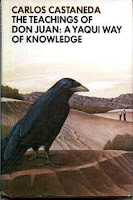
For many of us, The Teachings of Don Juan was our first glimpse into a shamanic world at once magical and meaningful, not just for primitive and superstitious people in distant countries, but for ourselves. The character don Juan Matus was the teacher we all yearned for, an initiator into this dark and magical realm — self-contained, charismatic, cynical, intimidating, wise, loving us despite our flaws.
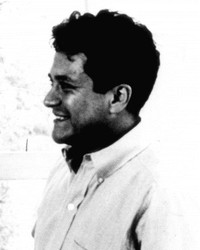 |
| Carlos Castaneda |
It was all, of course, a fraud. But we were willing to forgive Castaneda, at least for a while, because he was himself the trickster teacher, who had caught the spirit of our deepest needs.
Eventually it all unraveled. The books became increasingly bizarre and inconsistent. Detailed skeptical analysis revealed fiction after fiction. It seemed that every time Castaneda had a new enthusiasm, his purported teachers would have a new teaching. I stopped reading after the third book.
If you were not paying close attention — if you were not within the oddly contoured boundaries of Castaneda’s inner circle — it was easy to miss the accelerating weirdness of Castaneda’s final years. When he died of liver cancer in 1998, at the age of 72, the impeccable warrior left behind a legal mess, irreparable damage to Yaqui and Huichol cultures, and a core of female cult followers, at least one — and perhaps all — of whom committed suicide.
Soon after Castaneda’s death, The New York Times published an article about the lingering legal and familial chaos. In 2007, Salon published a comprehensive article about Castaneda’s last days and the fate of his followers, entitled The Dark Legacy of Carlos Castaneda. And in 2006 the BBC produced an hour-long documentary on Castaneda, which you can see, in four parts, here:

- Previous Post: How I Became a Sorcerer
- Next Post: Video Amazonia Indigena
- More Articles Related to: Books and Art, Indigenous Culture, Sacred Plants



I am no fan of castaneda. He seriously misinformed and confused people about native spirituality in Mexico. However, I am willing to give him the term that Alejandro Jodorowsky uses to refer to him. ” A sacred liar”. He was the reason many people decided to go into deeper levels of internalization and spirituality. Many so called shamans and nahuales came out of the cloth of his influence, but also many people found very solid cultural roots, elders, peace, commmunity and paths, out of starting their search with the reading of the teachings of don Juan.
But it isn’t spirituality, it’s BS. The teaching has no analogue in indigenous culture (apart from those who latched on tourists to make a fast buck). For example, what could erasing personal history possibly contribute to community life and what a doctor actually does – sacrifice his own interests to help others? Castaneda’s teaching is about selfishness. This led to the phenomenon called the plastic shaman. It all comes down to whether you grew up in indigenous culture or not. There are no ‘paths’. It’s all self-indulgent nonsense. If you’re not an Indian then you CAN’T be a shaman or ‘man of power’ or whatever – but you can become a danger to the Indians with your insanity.
Exactly, I was about to comment the same.
What is this obsession we have as western culture to determine exactly which facts are true, which aren’t? I see a lot of obsession in that, the need to feel smart, or snob, or to claim “i’m no fool”, “you can’t fool me”.
And, like chuntaro, i’m no fan of castaneda. He might be a liar, but I don’t care. The important thing is what happens to me when I read one of his books.
What I do care is that he was a sacred liar. The sacred part is the important one.
To say that Castaneda was a liar is the politically correct statement, the one that intellectuals, “smart” people are willing to hear. Are they willing to hear about the sacred part? Are they willing to give up on their obsessive need to evaluate which fact is true and which isn’t, and focus instead on what the book is saying?
I just hope that others who might benefit from reading Castaneda, don’t stop their search for truth because of hearing the judgment of “smart” people saying “that book is just lies”.
What was ‘sacred’ about Carlos the psychopath? If you want to learn something about the sacred and the profane, learn from the Aborigenes. Carlos is pure phantasy for the mush minded and gullible.
I can still remember the feeling when reading his first book. It was wonderful to have my attention directed to the world of indigenous spirituality and the feeling was one of real interest and the anticipation of adventures full of mysterious possibilities. It would be years before I heard about his work and stories being questioned while his character and authenticity were being run down hill. He was being “proved” to be a fraud. I felt misunderstood as a person that day and lonely because of it. I thought I had gained a sense of direction, the exploration of indigenous practices, but wondered if I was somehow being a fraud because the person who inspired me was being called one. For me the books were art, novels about possible ways that I hadn’t thought to explore until I read them. The truth wasn’t my concern. I wasn’t looking for the truth, or becoming someone who tells others what it is and isn’t after getting an education in it from those who are sure they know it.
What’s funny about passing judgment on the “truth” of his work or claims is that when your all the way inside of a ceremony with an indigenous elder in a medicine tradition that takes you into alternate realities you don’t usually spend the time determining the truth of the experience like some kind of credentialed detective. Questions certainly come up during and after, but if your in an alternate reality, or seeing through other eyes the world you normally see through your own,
it’s what you learn, or are inspired to learn that seems to me to be the most interesting part.
And if it’s true that there are other ways of seeing, other realities if you will, then who cares if the one Carlos was portraying wasn’t accurate in a single fixed and agreed on world view of so called “facts”, even if it’s subscribed to by millions.
No. There aren’t any other ways of “seeing ” reality. Where is your evidence? Isn’t enlightenment supposed to be acknowledging the existential truth of existence?
Thank you for posting this BBC documentary. I’ve been wanting to see it since I first heard about it. Now, at last, finally.
Castaneda’s impact is a complex, fascinating subject, a big part of a much larger story — of modern society’s historically recent acquaintance with consciousness-expanding compounds, and their influence on the perennial search for transcendence and meaning. Especially as it has been playing out in the counterculture.
Reading posts here, a quote from the native healer Black Elk came to mind. In recounting mythic stories of the Lakota (his people), he said: “… whether it happened so or not I do not know; but if you think about it, you can see that it is true” (p. 3, Neihardt, “Black Elk Speaks” 1932, Wm Morrow & Co.).
Black Elk recognizes truth is not limited to the literal, and includes more than mere fact, or historic veracity. But he doesn’t devalue fact, or the distinction between true and false.
Indeed, how far can the truth and wisdom of Black Elk’s recognition be extended? Can it be applied to Castaneda, or anyone who would fabricate stories, claiming they are nonfiction — i.e., honest accounts of field work, factual events? In the process making millions of dollars, cultivating a flock of devoted fans, etc.? To me this is a more significant question for evaluating the legacy of Castaneda than some voices seem to reflect.
I wonder what Black Elk would say about this if he were with us.
Thankyou for the quote from Black Elk. Therein lies the essence of the whole conundrum. When Paul of Tarsus wrote, anybody could see the truth of the Spirit which gives life, as opposed to the written word which kills. Carlos was not pointing the way, like Paul, or the Buddha, or Lao Tse, to truths that were self evident, that anyone could see with a natural sense of things. Carlos claimed special secret knowledge, that makes no sense whatsoever, that fooled a lot of people, and led them away from a legitimate path of spiritual development. Carlos enslaved his followers, he did not liberate them. There is nothing sacred about his lies. The Devil was known as the Lord of Lies, the Great Deceiver. There is nothing that is more liberating that the truth, with a small T. Carlos had all the earmarks of a true psychopath, utterly devoid of conscience, utterly indifferent to the consequences to others, a supremely selfish individual. But don’t take it from me, listen to the testimony of his wife and lovers…they all tell the same sad story.
Please, just stop thinking. Stop comparing. STOP THINKING and act. Grab the 3rd, 7th and 12th book of Castaneda, read each one at least three times. Please, don’t judge. Just read it. Hopefully you’ll see what’s all about. At that precise moment, you’ll not care anymore about the truth or not truth, because you will EXPERIENCE it. At that precise moment, it doesn’t matter anymore what “wives”, “lovers”, “fans” or “druggies” say. Because you will KNOW what’s all about. If not, all I can say is: I’m sorry.
Castaneda was a fraud, a liar, and a self-interested manipulator of vulnerable people who deserves contempt, not accolades. That the mildly entertaining hocum in his books has now been comprehensively discredited is most gratifying.
The ‘proofs
'that Castaneda was a ‘fraud'by Richard de Mille are a complete farce. And Fikes claims about Castaneda and the Huichols is idle fantasy; Castaneda worked minimally with the Huichols. His books are so authentic and beautiful that legions of followers created problems for some native people. That is a human tragedy, but not the responsibility of the author.Carlos Castaneda was an authentic explorer of the reality that exists ‘beyond the five sense.’ He found an affinity in indigenous thought/culture for openness to perceiving that reality. He was a lifelong prodigy as a storyteller. He brought that talent to relating readable stories of his authentic experience with one secret indigenous tradition. He neither was, nor ever purported to be, a spokesman for any USA or Mexican indigenous people. Furthermore, he personally had interest in the ‘cognitive system’ of the people he learned from, rather than any other anthropological/psychological/religious or whatever interest. So he presented the wisdom sytem that he experienced in Mexico and the SW USA from his own, what I would call ‘philosophical’ interest, which he consistently articulates as his motive, and nothing more. The fact that he made money is a tribute to his talent. The fact that he in later years used his acquired ‘power’ in some instances irresponsibly is a human failure, which does not diminish his literary accomplishment. For many such as myself he has been one of the most inspiring writers of our time, from start to finish.
You may have been inspired–but to what end? You do not demonstrate the slightest insight into the nature of reality or how to recover one’s original nature. My view, for what it is worth, is that you are utterly lost in Samsara.
But Castaneda did not ‘learn’ from anyone. Everything is fake. And that is the contribution of DeMille, which cannot be denied. Except by those who deny scientific facts. Castaneda must be vilified because he damages his readers.
The questions regarding authenticity; and the existense of a character like ‘Don Juan’, could be perceived as a natural extension of the very conditioning Castaneda’s ‘followers/fans’ seek to rid themselves of. Or do they?
Rather than waste time proving or disproving the dead’s credentials, energy could be better spent examining the fraud within one’s self. A major precept within the ‘teachings’ themselves. We want the knowledge and ‘power’ that supposedly comes with it; but we still want to drag our reason along, kicking and screaming. Speculative judgements about complete strangers and their motives is a hell of a lot easier than examining and truly changing but one part of what you believe yourself to be.
Never met the man, or his cohorts. But at least it appears they died trying to acheive that which they (apparently) sought with such passion.The average person would gnaw their left toes off for millions of dollars, fame and fortune.Not too many would seriously devote the remainder of their lives to aquescing to something intangible and ultimately, indescribable.Who cares which one Castaneda was!
The real questions are best directed through rigorous, honest self-inquiry.The real answers will only ever breed more ridiculous extensions until they too are no longer required. If it’s managed before death, all the better.If not, meh…you can only die trying.
Some of us don’t want power. Some of us just want freedom from bullshit.
I enjoyed Castaneda’s books. I found them similar to the ‘Medicine Woman’ series.
The same search for spirituality with a shaman teacher. It doesn’t matter that someone says Castaneda is a fraud, his words for me are wisdoms that I feel any seeker of truth would understand.
When I read the ‘Teachings of Don Juan’, I noted that Don Juan’s first teachings to Castanada was ‘Don’t tell the truth’. As soon as I saw that I knew that this story was self referential and something was up. Those words were a warning sign saying ‘Danger – Take Nothing in this work literally. Let your mind enter at your own risk”
Exactly. One of the first things Don Juan tried to get across to Castaneda was that he had to let go of his academic obsession with establishing ‘truth’. The whole concept of ‘what is the Truth’ is a construction of the mind. One cannot let go of the mind while one is searching for the ‘Truth’. Castaneda was a trickster, ensuring only those who are ready and willing to let go of their obsession with logic and truth will ‘get it’.
Carlos was a genius. What is a truth or a lie to a shaman? Both create realities.
Agreement creates reality. Alignment creates reality. Carlos aligned a lot of
people to his warrior’s description. I have verified many of his teachings for
myself. I am truly grateful for his work. If you read the books the answers are
there. Two paths are described which share a common template – the path of
sorcery and the path of the seer. The seers are very much like nondualists.
Carlos was taught the old and the new, but don Juan remarked multiple times
that Carlos was more aligned with the Old sorcerers’ ways. So where is the
contradiction in his life? He abused his power just like the Old ones. And people
act surprised. Anyone who actually puts into practice the teachings would not
be surprised. These “victims” are ignoring the majority of the teachings of
the warrior’s way. They pose as insiders and make comments as outsiders.
If Carlos was a genius–then Mozart was not, Da Vinci was not, Einstein was not. Carlos was a psychopath and a fraud. And you are a victim.
Dr Tathata, please stop to be painfully judgemental, thank you.
Dr Tathata, who are you to judge who is lost in samsara? For all we know, the time you spend refuting peoples’ inspiration who like Castaneda’s books is the greatest testament to being lost in a mission to disprove- a mission which literally has no fruit to bear for anybody reading any of this. Calling people psychopaths leaves little room for understanding. There is often truth to be found in fiction, don’t forget this.
David, in your world, you make decisions regarding what you reject and what you accept, every day of the week, as you just articulated in your rejection of my rejection of the disinformation of Carlos the Fraudulent. I do not question your right to make judgements about the information presented to your senses–I push back not because I am on a mission to disprove, which is a different and separate objective entirely, one I am utterly disinterested in, but because by vocally rejecting false information whenever I am confronted by it–I affirm myself, positively. It’s a form of self-actualization, having nothing whatsoever to do with you.
“‘Everything exists’: That is one extreme. ‘Everything doesn’t exist’: That is a second extreme. Avoiding these two extremes, the Tathagata teaches the Dhamma via the middle: From ignorance as a requisite condition come fabrications. From fabrications as a requisite condition comes consciousness. From consciousness as a requisite condition comes name-&-form. From name-&-form as a requisite condition come the six sense media. From the six sense media as a requisite condition comes contact. From contact as a requisite condition comes feeling. From feeling as a requisite condition comes craving. From craving as a requisite condition comes clinging/sustenance. From clinging/sustenance as a requisite condition comes becoming. From becoming as a requisite condition comes birth. From birth as a requisite condition, then aging & death, sorrow, lamentation, pain, distress, & despair come into play. Such is the origination of this entire mass of stress & suffering.–Kaccayanagotta Sutta
Dr Tathata, I have edited your comment to remove what I believe was a personal attack. If you think that my editing has distorted your meaning, please let me know. The use of the word “you” is often a hint that a personal attack is about to take place. Please feel free to speak honestly from your heart, but please refrain from characterizing others. Thanks.
I am done presenting my views to anyone who does not recognize the absolute unconditional nature of freedom. “Give not that which is holy to the dogs, neither cast you your pearls before swine, lest they trample them under their feet, and turn again and rend you. And as ye enter into the house, salute it. And if the house be worthy, let your peace come on it: but if it be not worthy, let your peace return to you. And whosoever shall not receive you, nor hear your words: going forth out of that house or city shake off the dust from your feet. Them that have ears, let them hear.”
I have deleted three comments that seemed to me to cross over the line from vigorous advocacy to personal attack. This is my house, and in my house we do not attack each other or call each other names. I know that there are people who consider invective to be a sport, but I do not. Some earlier comments in this thread came very close to the line, but I let them stay, because I recognized the passion behind them. But I did not intend to encourage nastiness, and I am stopping it now. There are too many thoughtful and interesting ideas expressed by commentators throughout this blog to spoil them with mere bad temper.
Let’s start by recognizing that there is a fundamental, unacceptability about unpleasant truth. We all tend to shield ourselves against its wounding accuracy. Not only do we do this as individuals, but we do this as a people, as a tribe, as a nation. Twenty-seven hundred years ago, as some of you may remember, not because you were there, but because you might have read the Bible, the priest Amaziah said of the prophet Amos, “…the land is not able to bear all his words.”
Every prophet has realized that nobody loves you for being the enemy of their illusions. Every prophet has realized that most of us want peace at any price as long as the peace is ours and somebody else pays the price. That is why the prophet Jeremiah said, “‘Peace, peace,’ they say, when there is no peace,” and why Jesus said, “Do not suppose that I have come to bring peace to the earth. I did not come to bring peace, but a sword.” (Matthew 10:34 NIV)
Thank you sooo much Dr. Tathata, ’cause you are of great help to realize how much I’ve learned from Castaneda. I’m sooo grateful to him, ’cause every time I see around EVERYONE is packed with personal importance. We’re like chickens running from one side to the other without knowing what to do.
I haven’t found any similar knowledge, not in Buddhism, Christianism, Taoism, nor even Zen. The knowledge of ancient Mexico goes much further than any religion. I’m so happy for your comments because they make feel even more grateful and privileged by that knowledge that obviously was not made for everyone in the world (which is a real shame). But even more important, they make me realize that I’m just a person who will die, so I have no time to lose. Every second counts. Your comments make me realize that if Castaneda, even with so much wisdom didn’t make it through; then we have to work twice as hard. That’s the challenge of the sorcerer. Acting, not talking. Thank you!
Have a good time in Heaven.
Castaneda had no knowledge of his own. The majority of his teaching is based on phenomenology learned at UCLA and his drug fueled fertile imagination. Romanticizing the Indians? It’s easily done. Take a look at Ray Bradbury’s Martian Chronicles, for example. That describes US settlers’ guilt about their eradication of the Martians and desperation to contact the ancient Martian civilization But the Martians are always a malevolent presence; even their ghosts.
Castaneda pilfered Peruvian folklore and superstition and passed it off as Mexican. He spent his time in UCLA re-writing obnoxious left hand path tantra and ripping off other charlatans such as Muktananda. It’s all well documented. And of course, Castaneda sold distorted Gurdjieff Fourth Way teaching, like so many others have done.
What’s missing from Castaneda is any notion of suffering or sacrifice of one’s own needs for others. It’s a philosophy of pure selfishness derived from phenomenology, where subjective experience trumps responsibility. You can see why phenomenology appeals to counterculture druggies like Castaneda and Lilly.
One more thing. I don’t know if you’ve tried Castaneda’s exercises taught by him by Don Juan? Well, they don’t work. Except to make you into a obsessed and paranoid junky in every sense of that word.
I know this is a little late to the game, but I have to add my two cents, if only, just as the Nagual Carlos Castaneda would have said, “for the hell of it.” I studied with the apprentices of Carlos Castaneda for 15 years. In that time, I experienced much of what he taught and presented as possible, both in dreams and in waking life (not that there is really a difference.) I have had my own issues with the institution he left behind, known as Cleargreen, but it has nothing to do with him being a fraud. People call him a fraud because the premises he lays out scare the shit out of them; and rightfully so. The universe he provides access to is a world of pure energy, which places you beyond the social order, back into the original state of what humans truly are; magical beings with infinite capabilities. But you have to work at it to be a part of it. You have to constantly be aware of your ego and save your energy. People love Amazonian Shamanism because it is relatively safe. Take some aya, feel love, purge, or whatever but then go back safely into the fold of the social order: family, wife, husband, kids, jobs etc…It’s precisely the warmth and familiarity of human misery, and some joy of course, that draws people to these types of shamans. They have wives, children, joys, sorrow, petty fights, huge egos etc…in other words, much of what every human being has and identifies as familiar. The Nagual’s world is something far beyond that, yet, of course, you still have to deal with these things. As the nagual said, “the ego is a lazy dog. you have to sneak around it, not destroy it.” You have only (hahah “only”) to read his book “The Active Side of Infinity” in the section titled “Mud Shadows” to find out who the true enemy is, and it ain’t really us. People get angry and righteous and accuse him of fraudulent behavior because, deep down, they know it’s true; our mind is a foreign installation. The only true facts are energetic facts, and the two that really matter are that we are beings who are going to die and we are, at our core, pure energy. As the saying goes, “The wire is life, all the rest is just hanging around.” At least have the courage and humility to realize that all is possible, it’s just that you might not make it as far as you want to.
There is no such thing as “energetic facts”. It’s just gibberish, which you are using to blind your eyes from reality. What I mean by reality is the scientific laws that make up everyday life and which are empirically verifiable by experiment. At ‘core’ you are flesh and blood, which I can easily prove to you. Do you truly believe you can control your nervous responses to pain. Or that it is a good thing not to experience remorse for ones’ crimes against others? Because if you don’t have social order, you don’t have responsibility. But of course, you don’t want to be responsible for your actions or for the suffering of others which your selfishness will definitely bring.
Do you really think that the realm is made by the scientific laws? These laws are made by man and are real facts, no doubt. But do they create the realm. Dont think so. I have got interested of Castanedas books and in some point experienced kind of disappointment when realizing “this might be just one mans imagination”. At the end I dont care. Any way I believe that science is not ready full truth yet.
Navarth, if your comment was made in the presence of Castaneda and his cohort (many of whom had PhDs from top universities), it would undoubtedly produce a great round of laughter. Not out of any spite or lack of love for you, but in seeing themselves at a much earlier stage of understanding. Read all of his books, as well as books by Florinda Donner and other apprentices in the Don Juan line, and if lucky you will have less of an urge to defend the scientific rational worldview.
Controlled folly!
My impression is that he was a great story teller, telling stories that people wanted to hear and were ready to believe. He should have said his stories were fiction, and people should have been more circumspect. There’s a good lesson in that.
whatever one may say he wrote soem velly inderestink books.I thought at first they were true related events until isaw they were published under fiction,but that does not alter the fact of the books and his mind created the stories in those books and he wrote soem hellacious stories.I think psychopath,etc etc is alittle strong and a mis use of the word(possibly)if one permits oneself to becoem a slave to anpother pewrsonality well then ……they are free to walk at anytime i assume.yes using people is bad we all do it in one way or another.I found soem of the concepts in the books very profound,twas a pity they had crazy gringos running all over mexico lookin fer don juan,lol he was in the reservation in southern arizona a courtesy of amelikan govt since yaquis aint native to territoorial usa I gather.one of those professors should eat soem peytote and see if he meets mesacalito,many dmt users meet dematelita,or the yabba the hut type thing when dojing psycolcybe cubensis. sticky wicket ,what?
I thinks he’s funny. I dont believe he wrote any of those things with the mind that people will actually believe them to be true. Once in a while he makes reference to a truth you can actually connect with. Then the rest he just toys with u. The way I see it, when Don juan laughs at Carlos in the books … THERE … thats actually Carlos laughing at us. My take … Carlos is a genius :-)
Hey, I like it and it works for me. All that matters. Do what works for you. People’s spiritual experiences and beliefs are personal and all their own, not something that needs to be refuted by “fact” and so-called “evidence.” People have been a part of Castaneda’s system and will continue to be because it works for those people. Other people have walked away and found something else because it didn’t work for them. Personally, I pick and choose parts of his “system” that I feel work for me, recognizing that quite a bit of it came from Tibetan Buddhism, Taoism, and Gurdjieff, whom I much prefer. So be it. What’s the big deal? In the end, this is an intensely personal journey.
I don’t know why people say he was a fraud. They are tons of Shamans especially in Peru where he is said to be from. What makes them Shamans is the use of plants like Ayahuasca or whatever mind altering substance might be used to affect people.
Castaneda didn’t make it all up. I don’t think he ever claimed to be perfect. And anytime sex is involved we should all be quite forgiving. Sex is not the point.
What he wrote was interesting and pointed. What his followers did is irrelevant or what he did to the information that he displayed in his books.
The world is not as it appears, because it’s appearance is something that you learned from other people. There are many other ways of looking at things.